Judy's Breadsticks. Made Dad an open faced toasted sandwich with this great bread yesterday.
Very healthy ingredients and nice flavor.
Sunday, August 07, 2005

Saturday, August 06, 2005
Nuclear Bombs Aren't Cool.
Most of my friends know that I was an exchange student in Hiroshima as a junior in high school. My host parents and extended family there were survivors of the nuclear holocaust of August 6, 1945. My grandmother with her lilting Hiroshima-ben (dialect) told me in detail the most vivid pictures of her experience as a young nurse searching for her family members after the bomb struck. Living there and having the opportunity to keep hearing and taking in all the stories of friends, family exhibits, the Peace Park without my knowing at the time dramatically shifted my worldview. I've managed to collect a lot of books, videos and other materials - not as my life's work, but as a human deeply touched by the searing tragedy of one decision that cut a path of change through generations and inspired people I know to put the issue to the front of their lives. This is the 60th anniversary, and although my blog is really themed for looking for the 'cool' and new, something very uncool has its place in remembrance here too.
A dear friend just sent me a link to the Truthout site's collection of pieces today, which I post here.
No more Hiroshimas please.
T R U T H O U T
http://www.truthout.org/docs_2005/080505E.shtml
The Myths of Hiroshima
By Kai Bird and Martin J. Sherwin
The Los Angeles Times
Friday 05 August 2005
Sixty years ago tomorrow, an atomic bomb was dropped without warning on the center of the Japanese city of Hiroshima. One hundred and forty thousand people were killed, more than 95% of them women and children and other noncombatants. At least half of the victims died of radiation poisoning over the next few months. Three days after Hiroshima was obliterated, the city of Nagasaki suffered a similar fate.
The magnitude of death was enormous, but on Aug. 14, 1945 - just five days after the Nagasaki bombing - Radio Tokyo announced that the Japanese emperor had accepted the US terms for surrender. To many Americans at the time, and still for many today, it seemed clear that the bomb had ended the war, even "saving" a million lives that might have been lost if the US had been required to invade mainland Japan.
This powerful narrative took root quickly and is now deeply embedded in our historical sense of who we are as a nation. A decade ago, on the 50th anniversary, this narrative was reinforced in an exhibit at the Smithsonian Institution on the Enola Gay, the plane that dropped the first bomb. The exhibit, which had been the subject of a bruising political battle, presented nearly 4 million Americans with an officially sanctioned view of the atomic bombings that again portrayed them as a necessary act in a just war.
But although patriotically correct, the exhibit and the narrative on which it was based were historically inaccurate. For one thing, the Smithsonian downplayed the casualties, saying only that the bombs "caused many tens of thousands of deaths" and that Hiroshima was "a definite military target."
Americans were also told that use of the bombs "led to the immediate surrender of Japan and made unnecessary the planned invasion of the Japanese home islands." But it's not that straightforward. As Tsuyoshi Hasegawa has shown definitively in his new book, "Racing the Enemy" - and many other historians have long argued - it was the Soviet Union's entry into the Pacific war on Aug. 8, two days after the Hiroshima bombing, that provided the final "shock" that led to Japan's capitulation.
The Enola Gay exhibit also repeated such outright lies as the assertion that "special leaflets were dropped on Japanese cities" warning civilians to evacuate. The fact is that atomic bomb warning leaflets were dropped on Japanese cities, but only after Hiroshima and Nagasaki had been destroyed.
The hard truth is that the atomic bombings were unnecessary. A million lives were not saved. Indeed, McGeorge Bundy, the man who first popularized this figure, later confessed that he had pulled it out of thin air in order to justify the bombings in a 1947 Harper's magazine essay he had ghostwritten for Secretary of War Henry L. Stimson.
The bomb was dropped, as J. Robert Oppenheimer, scientific director of the Manhattan Project, said in November 1945, on "an essentially defeated enemy." President Truman and his closest advisor, Secretary of State James Byrnes, quite plainly used it primarily to prevent the Soviets from sharing in the occupation of Japan. And they used it on Aug. 6 even though they had agreed among themselves as they returned home from the Potsdam Conference on Aug. 3 that the Japanese were looking for peace.
These unpleasant historical facts were censored from the 1995 Smithsonian exhibit, an action that should trouble every American. When a government substitutes an officially sanctioned view for publicly debated history, democracy is diminished.
Today, in the post-9/11 era, it is critically important that the US face the truth about the atomic bomb. For one thing, the myths surrounding Hiroshima have made it possible for our defense establishment to argue that atomic bombs are legitimate weapons that belong in a democracy's arsenal. But if, as Oppenheimer said, "they are weapons of aggression, of surprise and of terror," how can a democracy rely on such weapons?
Oppenheimer understood very soon after Hiroshima that these weapons would ultimately threaten our very survival.
Presciently, he even warned us against what is now our worst national nightmare - and Osama bin Laden's frequently voiced dream - an atomic suitcase bomb smuggled into an American city: "Of course it could be done," Oppenheimer told a Senate committee, "and people could destroy New York."
Ironically, Hiroshima's myths are now motivating our enemies to attack us with the very weapon we invented. Bin Laden repeatedly refers to Hiroshima in his rambling speeches. It was, he believes, the atomic bombings that shocked the Japanese imperial government into an early surrender - and, he says, he is planning an atomic attack on the US that will similarly shock us into retreating from the Mideast.
Finally, Hiroshima's myths have gradually given rise to an American unilateralism born of atomic arrogance.
Oppenheimer warned against this "sleazy sense of omnipotence." He observed that "if you approach the problem and say, 'We know what is right and we would like to use the atomic bomb to persuade you to agree with us,' then you are in a very weak position and you will not succeed.... You will find yourselves attempting by force of arms to prevent a disaster."
Kai Bird and Martin J. Sherwin are coauthors of American Prometheus: The Triumph and Tragedy of J. Robert Oppenheimer, published earlier this year by Knopf.
Go to Original
Witness to the Ghosts of Hiroshima
By Matt Condon
The Age, Australia
Saturday 06 August 2005 Left:Radiation burns on the back of Kiyoshi Kitsukawa, a Hiroshima tram conductor who was standing with his back to the blast about 1000 yards from the centre of the explosion.
He was a small old man and he sat alone in the tram. It was late July and very warm and the tram was making its way through the southern suburbs of Hiroshima to the ferry terminal for the sacred island of Miyajima. The old man wore a large, floppy-brimmed canvas hat and a beige safari suit. He cradled in his lap a small bag. He had been watching me since I boarded near the A-Bomb Dome and sat on a bench opposite him.
As the tram emptied stop by stop along route two, he continued staring through his pair of enormous, thick-lensed spectacles. On occasion, I glanced at his kind, worn face and realized there was something not quite right with it - his features were curiously out of alignment. His left eye was smaller than his right, the difference exacerbated by the thick spectacle lenses. The cheekbone below the pinched eye was flat, in defiance of the other, which was round and full. It looked, to me, like a face that had suffered an accident a long time ago, and the imperfections were far away, on the horizon of a long life. At one point, it was just me and the old man in the tram, and this was when he rose slowly and sat beside me. "Where are you from?" he asked. His voice was thin and his English heavily accented but clear. "Australia," I said, turning to him.
He stared down at the carry bag in his hands. "Are you a soldier?" he asked.
I laughed at the unusual question. "No," I said.
"I remember the Australian soldiers in 1945," he said, "with the hats." He folded up one side of his canvas brim, making an impromptu slouch hat. "Very nice," he said, smiling.
Australian soldiers had taught him to speak English at a school in Hiroshima after the war. He had been born in 1928 and had been a "ship man" when he was younger. He gripped an imaginary ship's wheel with his old hands and motioned to steer from left to right. Then he said, unexpectedly: "I am of the atom bomb."
He rummaged in his carry bag and I noticed that the texture of the skin on his left hand was very smooth, an oddity consistent with his eye and his cheekbone. He was an old man divided into two sides. Eventually he produced a thick blue booklet the size of a passport. I had read of these books carried by A-bomb survivors. They were medical record books. "I am going to the hospital," he said, holding up the book. "Every week I go to the hospital." He tapped his knee with the book before returning it to his bag.
"I was visiting Hiroshima on that day," he said, recalling August 6, 1945. "The atom bomb. Wooosh." He raised a bunched fist and flicked his hand open to indicate the explosion. He looked at me with that crooked face and smiled again.
"I am of the atom bomb," he said.
I had come to Japan to retrace the steps of legendary Australian journalist Wilfred Burchett. As a young reporter, and in that early grappling for mentors and models, I had known of Burchett for a singular achievement - he was the first Western journalist into Hiroshima after the dropping of the atom bomb. In the 60 years since Burchett filed his report, "The Atomic Plague", for London's Daily Express, it has probably remained the greatest individual newspaper "scoop" of the 20th century and into the millennium. It's impossible to know now to what degree Burchett was writing for history, but you get the feeling, from the opening line, that the young Victorian reporter had an eye to posterity: "I write this as a warning to the world."
Burchett was almost 34 years old when he made his solo journey from Tokyo to Hiroshima to bring the facts of the bomb's devastation to the world, as he put it. At tremendous risk to his safety, he took the long train journey south, traveling in that delicate period between the dropping of the bombs on Hiroshima and Nagasaki and Japan's official surrender. It struck me, as a journalist and a novelist, that one day I would write a novel about this chapter in Burchett's life. The story had everything - war, flight, danger, heroism and, at the centre of it all, one of the defining moments in human history. I made some cursory notes.
Years later, I was browsing through a book stall at a Gold Coast flea market when I came across an extremely battered copy of one of the prolific Burchett's polemic books, This Monstrous War. The book dealt with the Korean conflict. By now I knew more about his life, his evolution into a "radical" journalist and his ability to polarize readers, colleagues, even governments. He was accused of being a communist spy, a traitor, a fabricator. His own country, for a time, refused to grant him a passport and re-entry into Australia. Since Hiroshima, his reputation had wobbled and stumbled.
I developed a theory, too, that the impact of what Burchett saw in Hiroshima, and the scoop itself, changed something inside him: that the dropping of the A-bomb was a schismatic moment for mankind, and also for Burchett's psychology. The theory had no basis in fact. It was the fancy of the novelist, trying to find a way into the head of an undeveloped character. I was already knitting a person called Burchett with the grand, subterranean themes of an unwritten novel. The A-bomb divided the 20th century. So, too, would atoms split in the mind of my Mr. Burchett, altering his view of the world, perhaps sending a hairline fracture through his soul.
When the Iraq conflict broke out in the wake of September 11, 2001, and the world witnessed the manipulation of the media by America, and truth, as they say, became a casualty itself, I kept thinking of Burchett and Hiroshima. In that instance, his purpose was the pursuit of truth. That purpose may have been tangled up with notions of future fame and accolades, of promotion and financial reward, of changing the world.
It is the dichotomy of reporting: at some points in your career you write for the public, but you also write for other journalists. "This is what I got," you're saying, "and you didn't." It was a dangerous, renegade act (often the prerequisite for defining moments) for which Burchett was later vilified by US government officials, who claimed he had fallen victim to Japanese propaganda. In some ways, it went to the very definition of reporting.
In the context of the contemporary world, with television and print journalists "embedded" with US troops invading Iraq (the word itself, embedded, so quickly redefined and attached to the media), I thought of Burchett and that warm September in 1945 when he walked through the ruins of Hiroshima with his notebook. I felt that something had been lost. That we had mislaid something very important about, or within, ourselves. That in modern times the media was like sediment, layer after layer of it, rolled out over feeling and empathy and rage and all those human responses to things that happen in the world. That everything would set like sandstone, and one day, beneath the many strata, a little fossilized truth would be found, embedded, fragile as a mosquito.
I'd bought Burchett's book This Monstrous War for $1, but didn't realize until I got home that it had been inscribed by the author. His best wishes and signature were scratched onto the title page in blue ink some time in the 1950s. When you begin a writing project you accept, beyond logic or reason, all manner of superstitions, totems, coincidences and signs. You believe they will help guide the arrow.
Go to Original
Surviving Hiroshima: Keiko Ogura
BBC News
Friday 05 August 2005
Keiko Ogura was eight years old when the atomic bomb was dropped on Hiroshima. She still lives in the city.
I wanted to go to school, but my father said 'I have a very strange feeling today - you shouldn't go to school, stay with us'.
That morning I was on the road near the house and all of a sudden I saw a flash of bluish white light - a magnesium-like flash and soon after a big sound with dust, and I was blown away and fell on the ground.
I found myself lying on the ground near the house. I thought the house was just in front of me but I couldn't see it because everything had become so dark and many pieces of wood and roof tiles and rubbish were falling on my head.
There was black rain falling... It smelled bad and there were many spots on my white blouse
And in the darkness there was a strong, strong wind like a typhoon. I couldn't open my eyes but tried to get back to my house and in the darkness I heard somebody was crying - my brother and sister.
I was 2.4km from the hypocenter but houses nearer the hypocenter had caught fire and were burning.
I saw long lines of refugees, just quiet, I don't know why they were so quiet. There were long lines, like ghosts.
Most of them were stretching out their arms because the skin was peeling off from the tips of their fingers. I could clearly see the hanging skin, peeling skin, and the wet red flesh and their hair was burned and smelled, the burnt hair smelled a lot.
And many people, just slowly passed by the front of my house.
Parched
All of a sudden a hand squeezed my ankle. I was so scared but they said 'get me water'. Almost all the people were just asking 'water', and 'help me'.
I rushed into my home where there was a well and brought them water. They thanked me but some of them were drinking water and vomiting blood and [then] died, stopped moving. They died in front of me. I felt regret and so scared. Maybe I killed them? Did I kill them?
And that night, 6 August, my father was so busy looking after the neighbors, but when he came back he said: 'Listen children - you shouldn't give water, some of the refugees died after drinking water. Please remember that.'
As a little girl I was so curious. I climbed up the hill, near our house... I was so astonished - all the city was flattened and demolished
Then I felt so guilty, and I saw them many times in my nightmares. I thought I was a very bad girl - I didn't do what my father said - so I kept it a secret. I didn't tell anybody this story until my father died.
There was black rain falling, black rain mingling with ashes and rubbish and oil, something like that. It smelled bad and there were many spots on my white blouse - sticky, dirty rain.
In the morning people were moving, brushing away flies from their skin. My house was full of injured people.
But as a little girl I was so curious. I wanted to see what the city looked like. My house was at the bottom of a hill - I climbed up the hill, near our house, and then I saw the whole city. I was so astonished - all the city was flattened and demolished. I counted just a couple of concrete buildings.
In Denial
The next day some of the buildings were still burning, and the next day, and the next day, and for three or four days I climbed the hill to see what the city was like.
I have a brother-in-law. He was living almost at the centre of the city - his family was very close to the hypocenter. Until now his family members were missing and he didn't want to recognize they were all gone, so he refused to say and report the family's names to the officials and he didn't want to visit Hiroshima.
Right now, he is living far away in Tokyo, and only last year he decided to report to Hiroshima city that his family members - his mother and sister - had passed away.
And there were so many people [who saw] so many dead or dying, but actually, most of them made up their mind not to tell anyone about what they saw.
This interview is from the series 'August 1945', from 3-14 August on BBC Radio 4, at 8.55 BST Mondays-Saturday, and at 9.55 BST on Sunday.
(In accordance with Title 17 U.S.C. Section 107, this material is distributed without profit to those who have expressed a prior interest in receiving the included information for research and educational purposes. t r u t h o u t has no affiliation whatsoever with the originator of this article nor is t r u t h o u t endorsed or sponsored by the originator.)
"Go to Original" links are provided as a convenience to our readers and allow for verification of authenticity. However, as originating pages are often updated by their originating host sites, the versions posted on TO may not match the versions our readers view when clicking the "Go to Original" links.
Friday, August 05, 2005
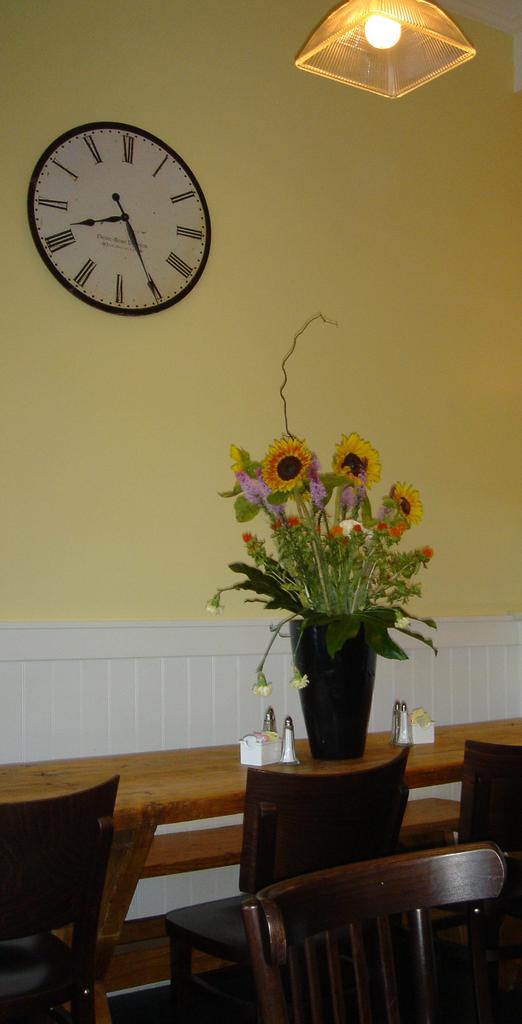
 Cafe Z. Well, well! Another find not found on the Internet. I took my own photos! Dad and I celebrated the end of his treatment this morning at this charming crepe and sandwich place which serves an awesome breakfast. Talking with the woman who took our $ and made our hot chocolate and mocha drinks, it's been around for about a year.
I noticed on the table that it serves supper now too, and Sally Sampson created the recipes. Good going Sally!
Cafe Z is in Greenbrae's Bon Air Shopping Center between Fifi's Diner and Peet's Coffee.
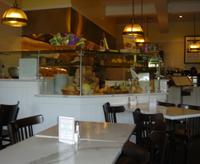
Here's a shot of the interior. Very inviting. Dad had a crepe filled with eggs, and I their carmelized onion and mozzarella scramble. Will definitely revisit.
Make someday today!
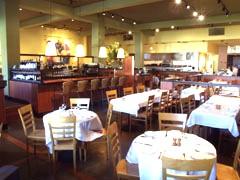 Of course, we had to end the last day with a dinner celebration too. Asked Dad what kind of food he'd like, where he'd like to go, he responded 'anywhere' 'you choose'.. so I just started driving. Ended up in San Anselmo, and noticed Insalata's -- one of those places that I passed frequently and thought 'someday I'll try it'.. well I stopped quickly and made 'someday' 'today'. Good idea. That was a really marvelous place! What inventive Mediterranean food. My fresh halibut was on a bed of Israeli couscous. I've never had Israeli couscous outside my home or Israel previous to this evening. Seems its an up and coming thing. The Fattoush Salad is totally inspiring. I'm so afraid of this one getting away, I'm going to replicate it below...
********************************
Syrian Fattoush Salad
As a fattoush maker for over 15 years, I know this salad like the back of my hand so I have some very helpful tips:
- Use only the hearts of the romaine--don't be tempted to use the tough outer leaves. Also, tear off the top of the heart if it seems limp and leathery.
- Traditionally, Italian parsley is used in place of cilantro, but I like the flavor balance of the mint and the cilantro. The size of a bunch of cilantro or mint in the summer months is double the size than in the winter. So, if you have big bunches in the summer, use 1/4 of a bunch, instead of 1/2 of a bunch.
- Splurge on French sheep's feta or a good quality imported feta cheese. It's rich with a nice salt and acidity balance. Don't skimp!
- Use fresh lemon juice, cumin seed and real Kalamata olives. Remember that the taste of the lemon juice varies through the year so use your buds and adjust accordingly. Adding a pinch of sumac to boost up the flavors of the lemons is one trick.
- Use fresh cumin seed, and not the pre-ground powder. There is a big difference in flavor when you toast the seeds to coax out their oils.
- And finally, don't buy canned, pitted olives. Take the extra time to pit real Kalamatas yourself. I promise that you'll be happy with the results!
Salad:
3/4 cup vine-ripened cherry tomatoes, halved
3/4 cup English cucumber, peeled, seeded and diced in 1/4 inch cubes
1/4 cup thinly sliced red onions (about 1/2 of a small red onion)
1/4 cup finely chopped cilantro (about 1/2 a bunch)
1/4 cup finely chopped mint (about 1/2 a bunch)
6 cups hearts of romaine lettuce (about 3 hearts), torn roughly by hand
2 pieces of pita bread
2/3 cup sheep's milk feta cheese
1/4 cup pitted Kalamata olives (about 12 olives)
Lemon vinaigrette:
1 teaspoon finely chopped garlic (about 1-2 cloves)
1/4 cup freshly squeezed lemon juice
1 tablespoon rice wine vinegar
3/4 teaspoon toasted and freshly ground cumin (see below)
2 ounces olive oil
5 ounces extra virgin olive oil
Salt and freshly ground black pepper
Serves 6 as a side dish
To make the pita chips, preheat oven to 350˚. Trim edges off of the pita, keeping a circle shape, so that the pita can be split into two halves. Cut each half into 6 triangles and arrange on a baking sheet. Toast for approximately 12 minutes, or until the pita chips crisp up and are golden brown. Turn baking sheet halfway through baking. Set aside and cool. Break the chips into large pieces.
To make the vinaigrette, in a small saucepan over medium-heat, toast cumin until aromatic and light brown, approximately 3 minutes. Toss occasionally to prevent burning. Let cool and set aside. Grind in a spice grinder until cumin becomes almost like powder. In a medium bowl, whisk together the garlic, lemon juice, rice wine vinegar, cumin, extra virgin olive oil and olive oil. Season to taste with generous amount of salt and black pepper. Set aside.
To serve, toss romaine hearts, cherry tomatoes, feta cheese, mint, cilantro, red onions and olives with the vinaigrette in a large bowl, making sure that the leaves are well coated with the vinaigrette. Divide the salad among 6 chilled salad plates. Serve immediately.
Sidebar:
Sheep are the most important dairy animal in the Mediterranean. In much of the Middle East, the sheep's milk cheese of choice is feta. Look for imported sheep's milk feta cheese which has been barrel aged. To feta aficionados, there is no comparison between artisnal-barrel aged feta and the feta produced in huge automated factories. However, given the expense and in some areas the unavailability of barrel-aged feta, feta cheese imported from Greece, France and Bulgaria are your next best bet.
Thursday, August 04, 2005
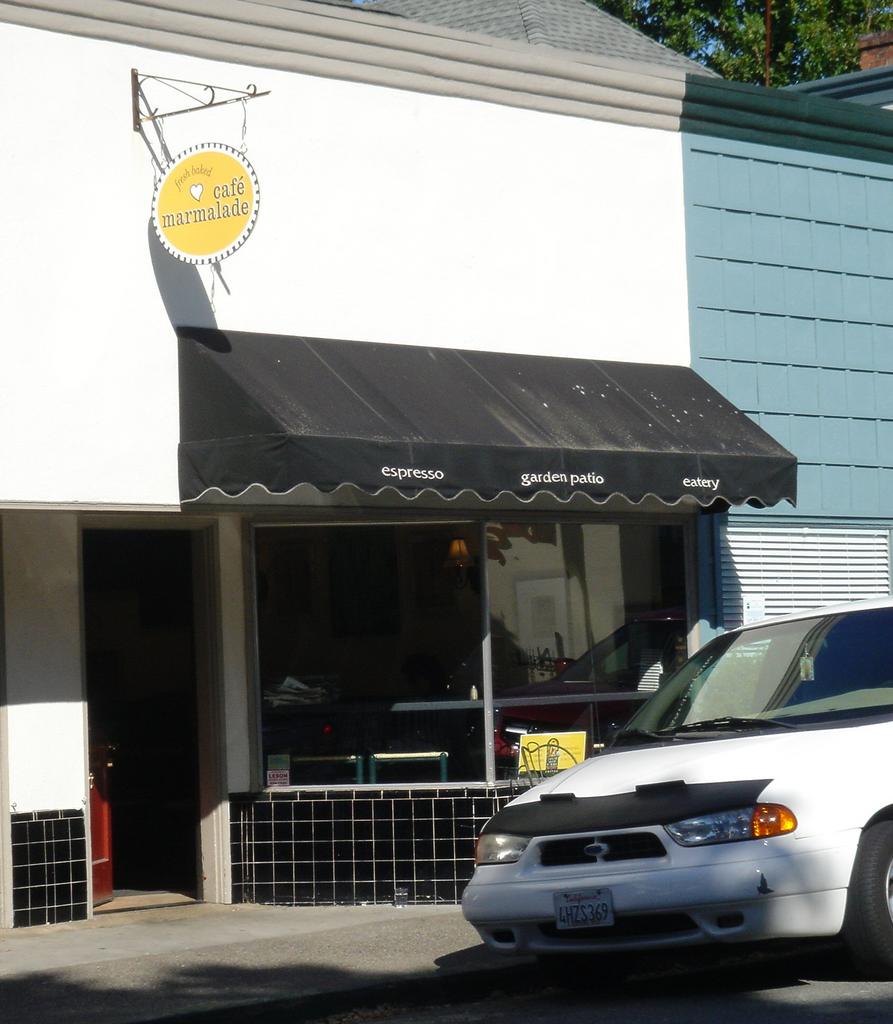 Cafe Marmalade. This cafe advertising 'freshly baked' in Ross, looks cute, but fails to stand up. A big part of their menu for breakfast were bagel creations, but they had no bagels. So we chose sweets and cafe mocha. The cafe mocha was served in chipped cups, and the place looked a little unkempt, including the garden which could be charming with a little attention. Music was piped into the garden, French songs at first, changing to Indian, which didn't match the mood of the garden although I liked the tunes.
The town of Ross is charming and well worth a stroll through the tree lined commons. It looks like a charming small town, locked in a past time, but kept that way intentionally and artistically.
Wednesday, August 03, 2005
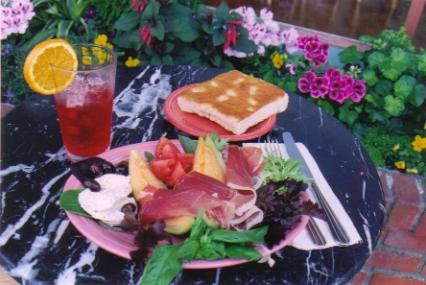 Caffe DiVino. This is a two-day post because basically, we were homebodies the last two days... going to UCSF in the morning for Dad's treatment and then lounging at home. Well, I did work from home too which left less 'play' time, but I don't want to exhaust ALL my vacation time.
This morning we attempted to visit the Winship, but contrary to its advertised open times during the week for breakfast, it was most definitely closed. So we went to a most charming Italian caffe on Caledonia Street, Caffe DiVino. The owner is very much in sight and took our orders for the unique Italian omelets. Very good, and creative, pleasant interior with original art work on the walls and multi-colored wood inlaid tables.
Monday, August 01, 2005
 Ramp Bulbs or "Wild Leeks". Had to pick up some of these at the Ferry Building when I saw them at Far West Fungi. I made Dad lunch of a pizza with whole-wheat crust, some of these wild leeks, heirloom tomatoes, porcini mushrooms, Canadian bacon, and organic mozzarella cheese.
He was feeling so perky, we went late afternoon to visit the Winchester Mystery House in San Jose, which was surprisingly just across the street from Santana Row, so we window shopped and had dinner at Maggiano's Little Italy. A very nice celebration for the 'real' last day of chemo!
Sunday, July 31, 2005
Must Love Dogs. Today's adventure was going to see this movie after some shopping for Dad. I made some nitsumono and hijiki rice for dinner. We both enjoyed the movie.

My friend Haruko. Linda and I were just wondering about Haruko yesterday, and what do I see in the paper today? An article quoting her. She's a major mover in the anti-nuclear movement in Japan. I copy the article form the Globe and Mail below.
'It's been 60 years, and people are forgetting'
By Geoffrey York
HIROSHIMA, JAPAN -- The A-bomb survivors knew their peace movement was in trouble when they were banned by an Atlanta school board and heckled by hostile Americans at a peace march in Washington.
The elderly survivors of Hiroshima are rarely invited to speak to the world's children these days. The global mood has turned hawkish. New countries are acquiring nuclear weapons. And with the U.S. administration refusing to co-operate, the latest disarmament talks at the United Nations collapsed in disarray this year.
For decades, the Japanese survivors were the heart and soul of the global peace movement. Now their generation is dying, and the world's memory of Hiroshima is fading. Even with the 60th anniversary of the atomic bomb approaching on Aug. 6, few people are listening to their message.
One of the most poignant symbols of their movement -- the concept of "ground zero" as the epicentre of the first nuclear blast -- has been appropriated by New York, where the phrase now refers to the location of the events that occurred there on Sept. 11, 2001. Those attacks and the more recent ones in London, rather than the decades of nuclear terror that began in Hiroshima and Nagasaki, dominate today's global consciousness.
"Most of those with direct memories of the atomic bomb will pass away in the near future," said Chisako Takeoka, a 77-year-old survivor who found her mother's horribly injured body among the wreckage of Hiroshima.
"It's a big challenge for us. We're asking the younger generation to carry on our stories."
Hiroshima was the dawn of an era of nuclear dread. Even when the Cold War ended, the nuclear powers maintained their missile arsenals and new states joined the nuclear club. Nuclear weapons are millions of times more powerful than anything that hit New York or London or Madrid in recent years, yet their presence has fallen off the world's mental map.
Ms. Takeoka, like hundreds of other survivors in Hiroshima, has dedicated her life to educating the world about the effects of nuclear bombs. But even as nuclear weapons spread to new countries, from North Korea to South Asia, she sees the world losing interest.
"People are more interested in the anti-terrorism campaign," she said. "The focus has shifted away from nuclear weapons. Of course the war against terrorism is important, but nothing can compare to the horror of a nuclear bomb."
Today's nuclear weapons, thousands of times more powerful than the bomb that fell on Hiroshima, would cause the slaughter of all humanity, she said. "I feel very sad about the world. I have a feeling that ultimately some country will use nuclear weapons again."
For more than 35 years, the city of Hiroshima has protested against every nuclear test around the world, acting as a voice of conscience for the victims of nuclear attacks. For a while, the protests seemed to be making progress. After hitting a peak in 1987, the number of nuclear tests declined sharply when the Cold War ended and dwindled to almost none in 2000. But since Sept. 11, 2001, the nuclear tests have gained momentum again.
The protest letters, signed by the mayor of Hiroshima, cover four walls at the Peace Museum in Hiroshima, reaching a total of 588 today. Nine nuclear tests have been conducted since Sept. 11, 2001, eight by the United States and one by Russia. There are so many protest letters that the display space is running out. Just six more letters can be posted in the museum exhibit before the walls are filled.
The backlash against the atomic bomb survivors is already beginning.
One group of Hiroshima and Nagasaki survivors and children of survivors was invited to speak to a high school in Atlanta in 2002, but the invitation was abruptly cancelled.
"It was done at the 11th hour, at night," said Haruko Moritaki, whose father lost an eye to shrapnel when the bomb fell on Hiroshima. "We were labelled as opponents of George Bush. Most ordinary Americans have learned no lessons from Hiroshima and Nagasaki."
When the survivors joined a peace march in Washington, they were jeered by passersby who shouted, "Go home!" and "Remember Pearl Harbor!"
Peace education, once a mandatory subject in Japanese classrooms, is now disappearing from the curriculum.
Shoji Kihara, a peace activist and son of two Hiroshima survivors, said Japanese schools have largely eliminated the peace memorial meetings and peace textbooks that were common in the past.
"There used to be so many teachers who were survivors, but now they are mostly retired," he said. "The second and third generation of teachers don't know the reality of the A-bomb. It's been 60 years, and people are forgetting about Hiroshima and Nagasaki. But the world is more dangerous than ever."
Last spring, the Hiroshima survivors watched the collapse of the latest UN review of the nuclear Non-Proliferation Treaty. At the previous review, five years earlier, the United States had agreed to affirm the long-term goal of all nations to eliminate nuclear weapons. But this year the review fell apart because the United States refused to co-operate on disarmament issues.
"These are dark days for the peace movement," said Sunao Tsuboi, an 80-year-old Hiroshima survivor.
Still, he is not giving up hope. "We're in a transition period. But in the long run, I'm convinced we will win. The wind against us always makes us more determined."
 Hint water. Slightly more of the bitterness of the natural cukes that I'd like, but overall a unique and refreshing drink.
Hint water has other flavors too; tangerine or pear may be a better pairing for essence without sugar.
Saturday, July 30, 2005
 Saturn White Peaches. After starting the morning spritely with a leisurely breakfast at the Dipsea in San Rafael with my fellow Shadow Dancing ladies, I took their advice about meandering throught the charming town of Ross. I did my shopping at Woodland's and picked up these peach beauties as a treat for my Dad.
Later, gave Dad a list of possibile things I could whip up for lunch, and he chose the pizza. So I rolled out a garlic herb crust and topped it with Canadian Bacon, fresh heirloom tomato slices, fresh morel mushrooms and a four cheese mix. It it was great, chased by the above mentioned peaches.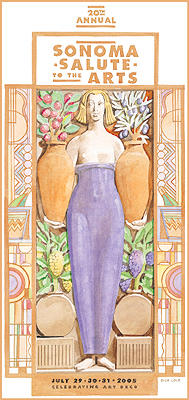
Salute to the Arts. On my way to this, will post more details later.
Well, back from Sonoma, and we circled this and decided not to go for a number of reasons, not the least of which was that Olivia was with us, and at 4 may not have enjoyed it $35 dollars worth.
So... we went to see March of the Penguins, a very good film, and yes, even though G rated, it wasn't the most exciting for Miss Olivia either.
We ended our evening with dinner at Kirin in Santa Rosa, which consitently makes good Chinese food. Potstickers, vegetable fried rice and Champagne scallops were our choices there.
I picked up Dad who enjoyed his time at his place, the Wine Country House, next weekend he'll be moving back.
The weather is simply beautiful, and what a nice pink sky as the sun went down. I've opened my sliding glass doors to let the sea breeze blow through.
Will sure be happy when I can put my BBQ and deck furniture, plants back where they belong! The painters have been working on it since July 15th, and it is still not finished.
Friday, July 29, 2005
The Art Bistro. Well this was a find this morning, new and not reported anywhere I can ferret out. This little gem is in the Richmond (33rd & Geary) close to the Palace of the Legion of Honor Art Museum. It has a bright red canopy and bright red round metal tables with red fabric umbrellas outside, and the inside is charming as well. Charming as in filled with green plants and many blooming lavender and linen-white orchids with a nice fresh smell, wicker funiture and pillows in soft greens, and one of the fabric umbrellas over one of the tables for effect. Primarily a coffee shop, it also has very fresh and lovely French/Italian pastries and they do breakfast bagels and croissants with a number of luscious breakfast toppings. The walls also had beautiful original paintings for sale, mosting gorgeous garden flower scenes. Dad sunk into one of the cushioned wicker seats near the window and leaned into the pillows sipping whipped-cream topped hot chocolate. Part of getting better, I think, is being surrounded by all the wonder that there is, to bring desire for living deeply for another day. So after treating my Dad to the Art Bistro stop, since it was near the Palace and Presidio, I took the meandering way home. We enjoyed the view of the city from the Palace, the fog had lifted enough to see a beautiful skyline. We meandered through the back view of the ocean and Golden Gate Bridge through Sea Cliff and the Presidio, and I took one more detour down Long Drive to the Crissy Field area, and found a charming park cafe, The Warming Hut, to come back and explore at a later date. There were runners of all ages along the drive and the air was marvelous.
Tonight, well Dad wanted to go 'out' for dinner, so we consulted my car, which called the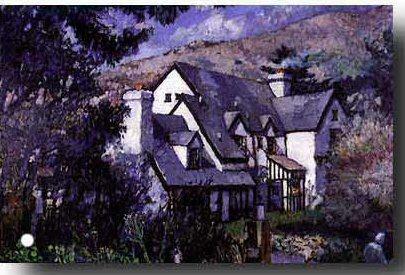 restaurant, the Pelican Inn to see if there was space for two. There was in 20 minutes, and we were there. The Pelican Inn is near Muir Beach, and has a lovely English country setting. We happened upon a wedding party posing for photos in front of the tudor style inn. The interior was very romantic, lots of lit tapers, a fire burning and a man playing harp (a lap harp of 44-strings). The trouble started with the food (fire the chef!)... Dad had a Ribbet (sprite & lime juice), I a Shandy (beer & sprite), then came a watercress, cucumber and strawberry salad for me, tomato soup for Dad. The salad was a large bunch of watercress dumped on a plate with two sliced strawberries and two slices of cucumber. Dressing was nearly non-existent, just applied to the stems of the watercress. Not good. Dad liked the soup. Dad ordered a main dish of vegetable pie, and I the signature dish, Beef Wellington. Dad's pie had large barely cooked vegetable pieces in an unremarkable tomato sauce, he could barely take a few bites. Mine had RAW red potatoes, rather than roasted red, and my 'medium' beef, was very well done, yet the pastry very pasty. So, very definitely a romatic spot for a drink and some small appetizing bites, but the meals are definitely not edible.
Thursday, July 28, 2005
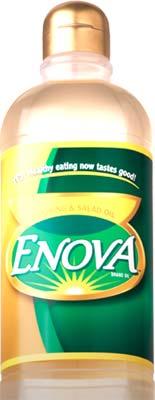 Enova. An all natural (not fat substitute) oil that has been enhanced for burning rather than absorbtion properties in the body. This was a Japantown find. Apparently, Kao invented it and it's been licenced here. Have to report use of it later, as I haven't tried it yet. Today I spent working at home and watching Dad, made some hijiki rice and a veggie melt for dinner. Dad wanted to see a comedy, so we watched a TERRIBLE film on On Demand Cable, Super Troopers. It was really not worth the time, but Dad got a few chuckles when he wasn't being appalled.
I also did some evening exploring of a new webservice introduced to me by my friend Cliff. It looks really fun, and just up my socially inclined alley.. see Bay Area Link Up. I think anyone can find an interest to follow and meet new friends there!
Wednesday, July 27, 2005
Bad surprise. Took Dad to Max's for a nice breakfast, but soon thereafter he took a tumble which colored the rest of the day. Stayed home and stood watch per doctor's orders. The second bad surpise, that ocurred earlier was finding out Dad's treatment has been extended by a week :-(. Had dinner with Linda at the Wild Fox and caught up with a friend of ours, Jaison.
Tuesday, July 26, 2005
 Routine with surprises. Toran and Aurelia are just so cute, I had to post another picture from yesterday's Muir Woods adventure at the left. Dad's treatment was very quick this morning, and he was doing well, so I spent nearly a normal schedule at work. We didn't try any new things, I cooked at home making him a mini-quiche (frozen) for breakfast and some spelt linguine with broccoli, onions and ham for dinner (left over linguine freshened up). I spoke at length to my Aunt Dorothy, now 90 years old, and packing up boxes to move from Yakima to Sequim to be closer to her grandsons and son-in-law. Good timing as she's moving over the weekend, and I got her new address/phone #. She repeated to me that she's adopting me as a daughter now since we're both 'orphans' in the sense that my Mom's gone and her daughter's gone and we've been like family since before I was born. It's even more of a complex relationship than that, but enough for this post. Found out a friend has been diagnosed with breast cancer, a plague in Marin to be sure. We're in a great circle of women who hang together so I hope she'll find comfort in our friendship and varied life experiences we've all had of the tough as well as the fun.
Monday, July 25, 2005
 Muir Woods. After the usual hospital/chemo scene (Dad's last day of chemo!!!), and a bit of a nap, we met Jo-Ann, Toran and Aurelia for a lovely walk through Muir Woods. I snapped Toran and Aurelia in a hollow tree along the pathway. Toran wanted Auntie Anna to choose a dinner location, and she thought Joe's Taco
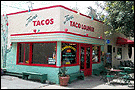 Lounge may be just the thing. And as usual with kids, although he said he wanted tacos, once he was there there wasn't a thing on the menu he was interested in having. We had a good time anyway.
Sunday, July 24, 2005
 Lazy day. Slept in, started the new Harry Potter book... met Linda, Yalda & Olivia for lunch at the Red Grape in Sonoma. Was disappointed that Erika couldn't make it up for a visit... Caught up on editing ECTV site. (I'm the Chief Editor of the Earth Changes TV webpage for the Front Page: Breaking Sections, gives me something to do in the wee hours when I can't sleep). Picked up Dad and heard an enthusiastic tale of his weekend at home. His lady friend apparently liked the surprise gift of chocolates that Dad asked me to help pick out on Friday.
Saturday, July 23, 2005
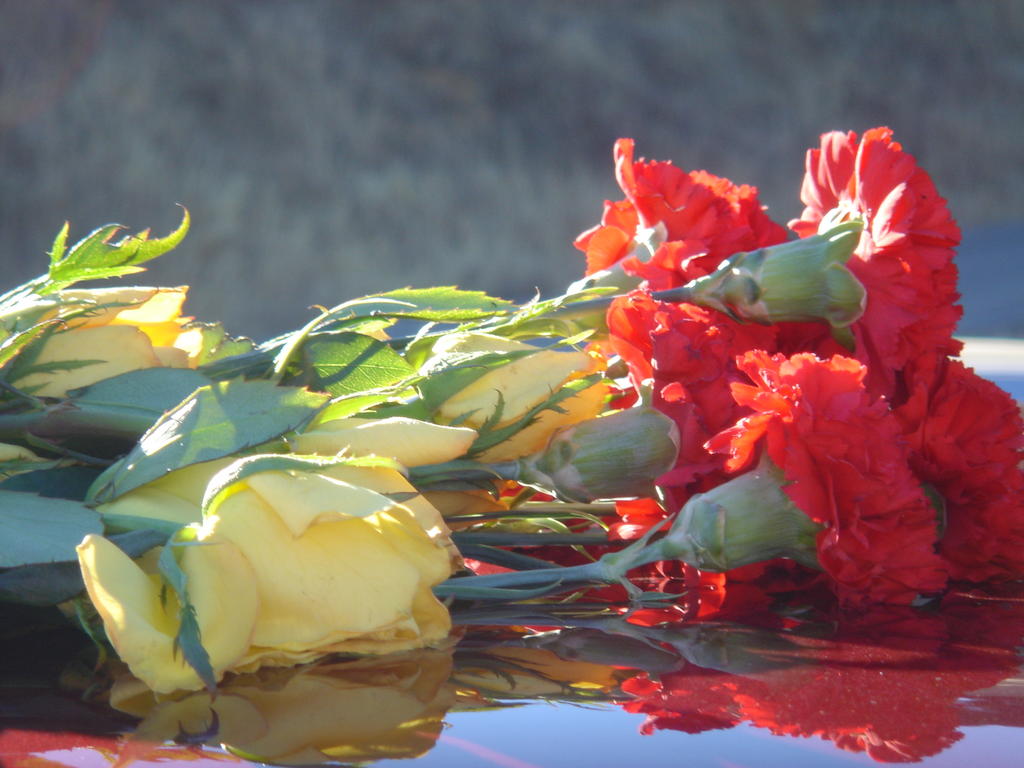
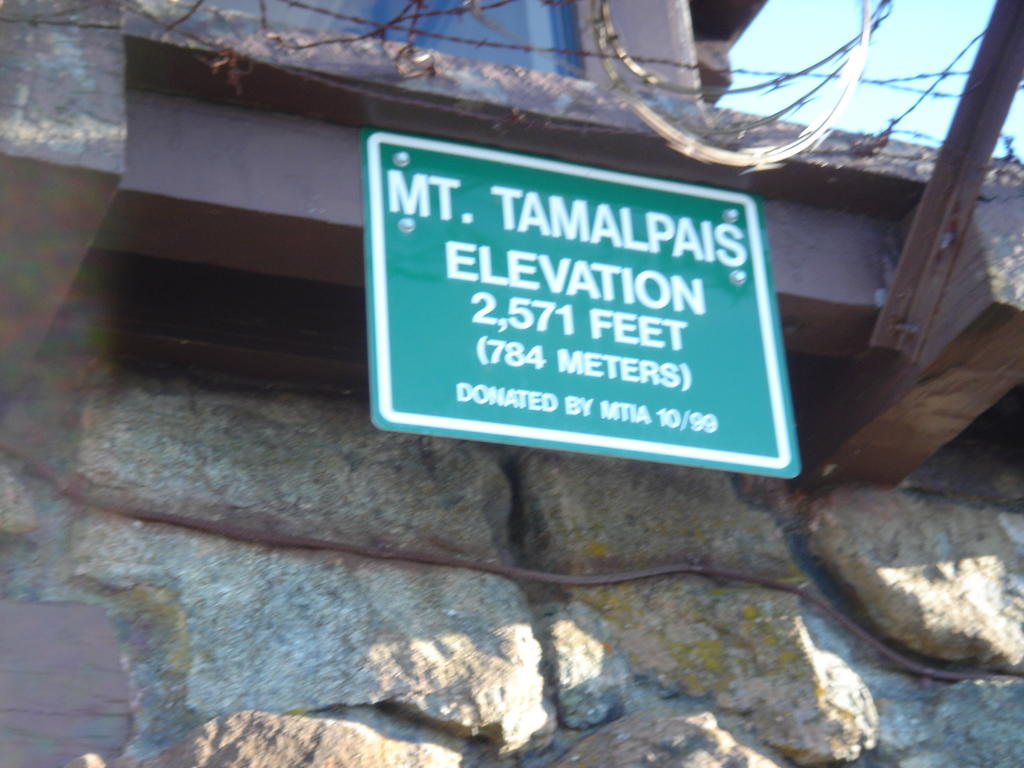 Mt. Tamalpais. A free day to myself! And what do I do? Fill it with friends, or a friend. After some creative photography sessions, Daniel and I went to the very top of Mt. Tamalpais, with a stop at my favorite picnic area. Going to the very top meant climbing rocks like a goat, but the view is well worth it. I had to take a photo of the elevation, and of some flowers placed on my car that Daniel rescued from the side of a cliff. We stayed until nearly sunset... see one of the photos I took from the top:
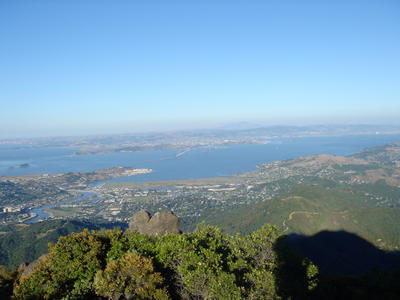
We lingered so long because of the breathtaking beauty, and watching the fog roll in... there was an interesting effect of one of the fingers that came through the Golden Gate first - a little leader piece appeared in the form of an angel at the head of Angel Island, wispily, and then broke up.
We missed timing for dinner, but went to see a movie that had it's world premier last night at the "Lark" in Larkspur. The film was a work of love and only cost $25K to film. "The Aviary" was very refreshing and original. And now I need some refreshment, so I'm off to Zzzland.
Friday, July 22, 2005
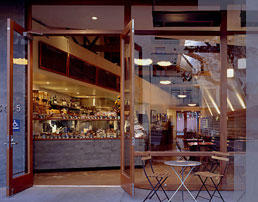 Rigolo. A darling French cafe on California in Laurel Village. The offerings are very French style, and it has an ambient charm. Dad had the French toast which was a little round of brioche permeated with egg and softly baked surrounded by a fruit compote. He raved. I tried the Croque Madam, which was a brioche topped with prosciutto, bechamel and guyere and a fried egg with fresh fruit as a side (choice of potatoes, breakfast meat or fruit). They serve breakfast and lunch as well. You order from the counter and wait while they cook... Rigolo means "a little funny" in French, but there's nothing funny about their delicious offerings.
Dad was feeling so chipper, he decided to go home for the weekend. So we stopped and had dinner at a charming place "Tador of Spain" in San Rafael. It's a tapas place so new I can't find reviews anywhere. I enjoyed trying a white sangria with the tastes.
Thursday, July 21, 2005
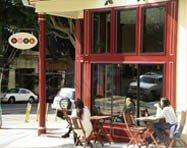 Nook. What a charming place. On the corner of Hyde and Jackson on Nob Hill, it truly is tucked in a nook. Contrary to my previous notes about parking being easier in difficult districts in early morning, this was difficult, and it is very hilly. However, taking the Hyde street Cable Car would be perfect for getting here. The breakfast menu is somewhat limited, mostly bagels, pastries and a couple hot items. My Dad tried the waffles, looked good and he was complimentary. I tried the breakfast wrap which was supposed to contain eggs, ham, beans and avocado, and it was toasted on the top, not just wrapped, and sliced decoratively with a side of lush greens. It was without avocado, but still good. Free Wi-Fi advertised too.
Sweet Ginger. Dad was feeling peppy this eveing and wanted to go out to a new place... so we went to Sausalito to a gem of a Japanese restaurant. Although it's been ages since I've been there, it is still as good. The miso bass had a melt-in-your-mouth texture and was perfectly flavored.

Subscribe to:
Posts (Atom)