 The Solio portable solar charger - green, cool and very handy.
(From Gizmag.com)
The words green and cool have traditionally not occurred in the same sentence but the Solio portable solar charger indisputably earns both adjectives and is increasingly relevant given that roughly one billion handheld battery-powered devices will be sold this year. The Solio achieves maximum solar panel area in a minimum of space, captures energy from the sun or a traditional power outlet in its integrated Lithium Ion battery, and will top up the herbs on an Apple iPod, mobile phones, digital cameras, PDAs and portable games consoles with its interchangeable tip system. Unlike some more obtrusive portable chargers, Solio’s award winning fan blade design allows it to be folded neatly to the size of a small mobile phone. This means Solio is highly portable, making it the perfect travel partner wherever you're going. The full Solio range is available now , prices start from UKP49.95/EU79.95. All units carry a full one year warranty.
Saturday, April 01, 2006

Saturday, March 25, 2006
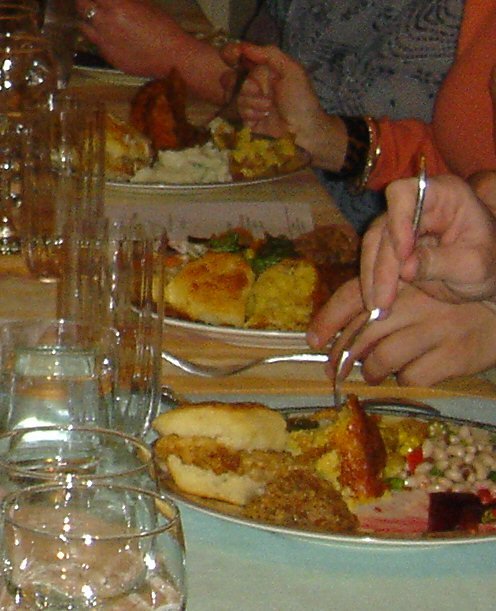 Supper Club does Southern. and how! Once again, the Supper Club got together 'round some good vittles!
For more description of the event, and the full, luscious wine list visit the March 26, 2006 posting at my friend Tom's site, Spirit & Spice.
The final menu:
Black-eyed pea salad
Birmingham beet salad with spiced pecans, pears, and Fourme d'Ambert
Southern once dipped fried chicken
Pulled pork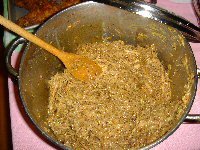
Chicken-fried steak biscuits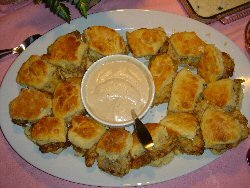
Mess o’greens and pot likker
Cornbread and cracklins with butter n’ honey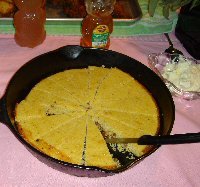
Blue Cheese Mashed Potatoes
Corn Pudding
Succotash
Yam souffle
Pecan Pie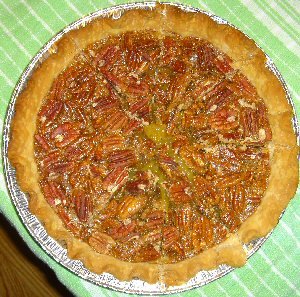
White raspberry/lemon filled cake
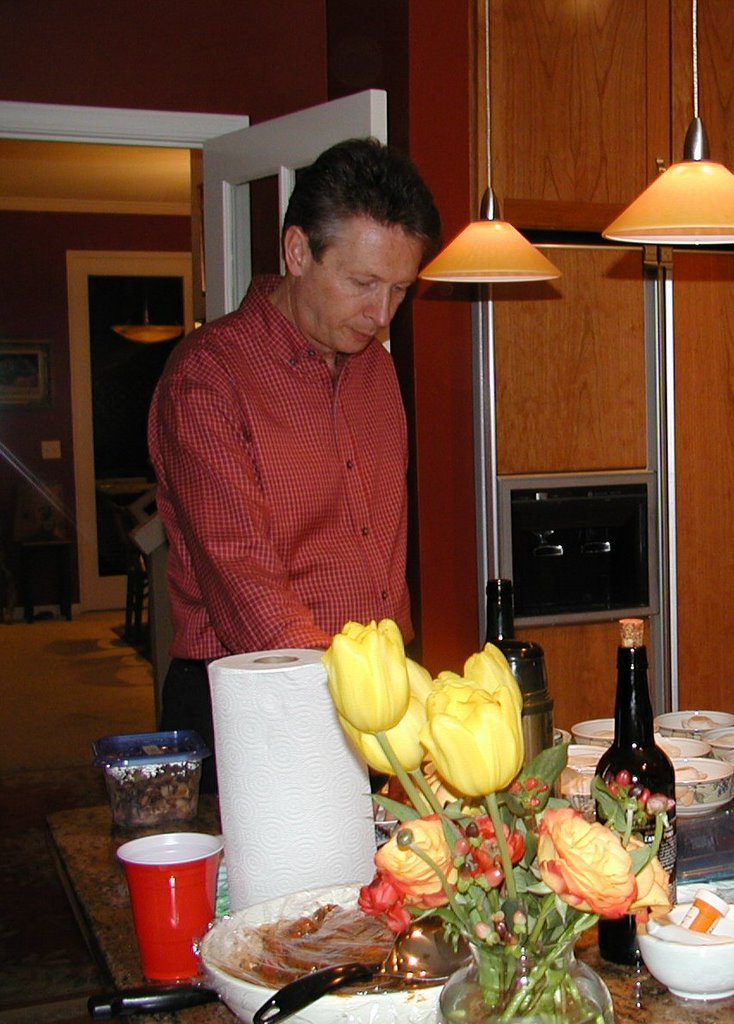
We have enormous fun developing our menus and savoring the food together. Here is a pre-meal shot of Paul, Leslie & Isadora engaged in conversation.
Back in the kitchen, Stephanie churns the butter while James considers the best timing for putting the finishing touch on his succotash.

Friday, March 24, 2006
It was suggested that I post some of my e-mail musings on Southern cuisine in coming up with my final offerings to the Supper Club for its Southern themed gathering on March 25th. They are below... Enjoy!
February 4th: I've been thinking... spent several hours trying to locate POSSUM meat... to the best I can determine, it's illegal to sell it :-( ... I found some really wild other kinds of meat for future reference though! My mother was from  Kentucky -- and she said that my great-grandmother (she was a child in the civil war era) used to make it occasionally, and it drove her Dad out of the house for a week! Guess it smells funny.
I'm trying to think of things that are practical as well because some of the recipes handed down from my mom are best prepared and served immediately for best flavor and I don't want to add to the kitchen hecticness.
I've also been referring to a book "What's Cooking in Kentucky" which is a spiral bound book which has real old fashioned country cooks recipes which can have some interesting instructions and side notes. (A distant relative of mine self-published it). I decided to pass on Kentucky Burgoo, which takes all day cooking and stirring outdoors, and serves 50. Not to mention it also takes steak, pork, chicken, squirrel & jowl bacon on the meat side...
I've been recently toying with something like Buttermilk Pie, Peanut Soup, something with Okra or Poke Greens, or Hominy (big or little).
So still in a state of research....
Can't wait!
Anna
PS. My mother also used to tell me stories of, and sometimes serve, some very unusual meat dishes which were popular when she was growing up... mostly organ meats. Scrambled brains & eggs for breakfast... sweetbreads... and she used to send me to school with Head Cheese Sandwiches. Although she didn't make it from scratch, I found this recipe for Head Cheese quite interesting.
Head Cheese
After thoroughly cleaning a hog's or a pig's head, split it in two with a sharp knife; take out the eyes, take out the brain, cut off the ears, and pour scalding water over them and the head and scrape them clean. Cut off any part of the nose which is discolored so as not to be scraped clean; then rinse all in cold water and put into a large kettle with hot (not boiling) water to cover it, and set the kettle (having covered it) overthe fire; let it boil gently, taking off the scum as it rises; when boiled so that the bones leave the meat readily, take it from the water with a skimmer into a large wooden bowl or tray; take from it every particle of bone, chop the meat small and season to taste with salt and pepper, and if liked, a little chopped sage or thyme.
Spread a cloth in a colander or sieve, set it in a deep dish and put the meat in, then fold the cloth loosely over it, lay a weight on which may press equally the whole surface ( a sufficiently large plate will serve); let the weight be more or less heavy, according as you may wish the cheese to be fat or lean; a heavy weight by pressing out the fat will of course leave the cheese lean. When cold take the weight off, take it from the colander or sieve, scrape off whatever fat may be found on the outside of the cloth, and keep the cheese in the cloth in a cool place, to be eaten sliced thin, with or without mustard and vinegar or catsup.
After the water is cold from which the head was boiled, take off the fat from it and whatever may have drained from the sieve or colander and cloth, put it together in some clean water, give it one boil, then strain it through a cloth and set it to become cold, then take off the cake of fat. It is fit for any use.
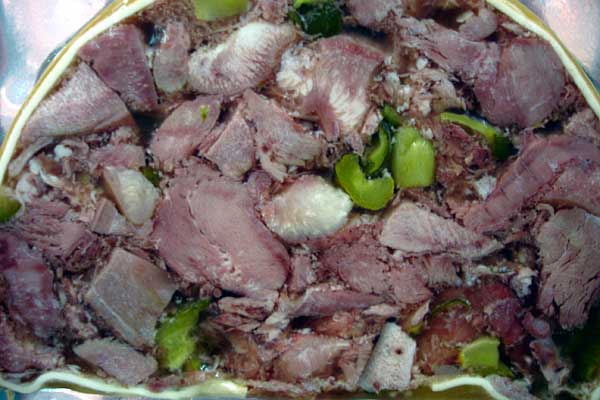
Well, don't think I'll be making the head cheese, but it is fun researching the old. Thought about making corncob wine, but it seems a bit techinical and you have to age it for more than 6 mos. I remembered my mother's 'hoe cakes' (yes, originally cooked on a hoe), creecy greens, cracklin bread, black-eyed peas (and various other unusual legumes), and chess pie. Still lookin'.
February 9th: Well fellow foodies, after reading the necessary actions to prepare good possum, I've given up! But it was fun to see it to the end. I was thinking of contacting my rather wild cousin in Kentucky to hunt one down for me and ship it on dry ice. However, as the following information states, it is especially important to keep it live for a few weeks and feed it a special diet before having 'him' for dinner. The thought of transporting a live possum via Fed Ex (if they even do it) and caring for it at my condo for a few weeks -- well I just couldn't picture it!
Enjoy this recipe from 1917 -- authentic! - Anna
PS I wonder what type of wine would have paired well ;-)
****************************************************************
The Preparation of Poultry and Game: Pick carefully, draw and singe every manner of poultry and feathered game, wash clean, quickly, in cold water, never hot, drain, then wipe as dry as possible with a soft, thick, damp cloth--it takes up moisture cleaner than a dry one. Keep very cold and away from smells until ready to cook. Tilt roasting fowls, so they may drain, if liquid gathers. Before stuffing rub over the whole inside lightly with soft butter or bacon fat, pepper it scantly, and rub on a very little salt. Grease and season the outside after stuffing is done,--never before it. If game is shot-torn, soak for ten minutes in weak salt water after plucking, rinse in cold salt water, wipe dry and drain.
Furred game, as rabbits, squirrels, possums, ought to be drawn before it is cold, if you would have the finest flavor. This is especially necessary with possums--which should be bought alive, and fattened for several weeks in a clean cage, feeding them on bread, milk, apples, potatoes, cabbage leaves, and grass. This makes them tender and much more delicate in flavor. Kill by dislocating the neck with a quick, upward jerk, then cut the throat and hang to bleed. Roll after dampening fur well in very hot embers--then scrape the same as a pig, draw, and hang to cool. Divide the skin of rabbits and squirrels around the middle, and pull off each half, the same as a kid glove. Thus no hairs stick on the clean flesh. Draw very quickly, wipe lightly with a damp cloth, and hang where it is cool and airy for at least an hour.
Possum Roasted: Chill thoroughly after scraping and drawing. Save all the inside fat, let it soak in weak salt water until cooking time, then rinse it well, and partly try it out in the pan before putting in the possum. Unless he is huge, leave him whole, skewering him flat, and laying him skin side up in the pan. Set in a hot oven and cook until crisply tender, taking care there is no scorching. Roast a dozen good sized sweet potatoes--in ashes if possible, if not, bake them covered in a deep pan. Peel when done, and lay while hot around the possum, turning them over and over in the abundant gravy. He should have been lightly salted when hung up, and fully seasoned, with salt, pepper, and a trifle of mustard, when put down to cook. Dish him in a big platter, lay the potatoes, which should be partly browned, around him, add a little boiling water to the pan, shake well around, and pour the gravy over everything. Hot corn bread, strong black coffee, or else sharp cider, and very hot sharp pickles are the things to serve with him.
Dishes & Beverages of the old South
By: Martha McCulloch-Williams
Published 1917
Monday, March 13, 2006
BLUE SUN: Spaceweather.com reports that for the second time this year, a blue sun has appeared over Egypt. "A powerful khamaseen dust storm swept through Alexandria on March 7th," reports astronomer Aymen Ibrahem of the Bibliotheca Alexandrina. "The sun shining through the dust turned blue."
The Egyptian sun on March 7th. Photo credit: Aymen Ibrahem.
Monday, March 06, 2006
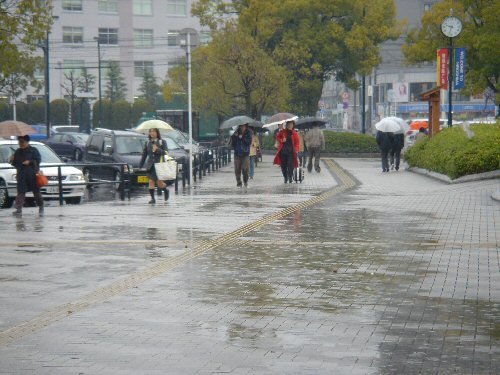 On to Okazaki. Monday, I took the Shinkansen to Mikawa-anjo and was picked up by Shinji & Fujiko and wisked off to their home. The timing of leaving Hiroshima was impeccable since it started pouring down rain. The colorful umbrellas seemed like spring blossoms moving gently down the sidewalk.
I arrived at the Hiroshima train station rather early, and enjoyed walking around nearby and appreciating the artfulness of Japanese packaging and arranging of goods for display at the stores.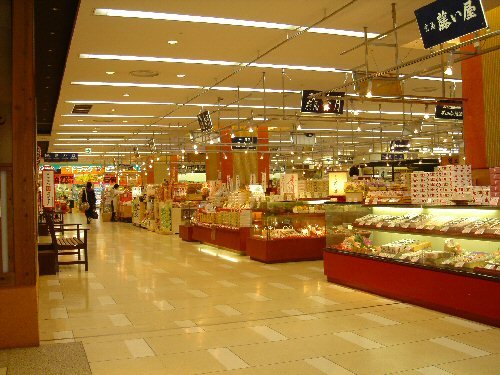
While I was waiting, a young woman smiled and started talking to me in English and we soon swiched to Japanese. She was a 'detail' person for Bayer, and was on her way for a business trip! What a coincidence. I guessed her job! I mused that it might be fun to buy a two week pass and sit for a time at each shinkansen station and see what the world brought me, and write up an article or expand on the sections for a book. Who knows???
Saturday, March 04, 2006
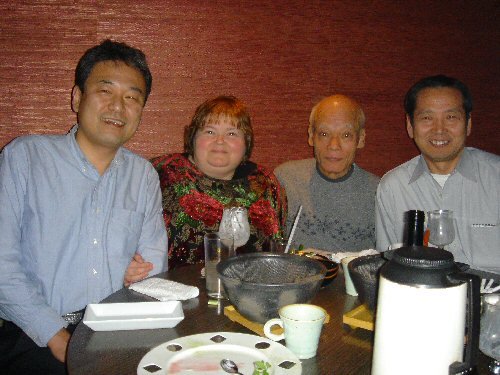 Reunion Party. My good friend and colleague Mr. Akimura kindly arranged to have a reunion party of some of my former supervisors taking place in Hiroshima. Mr. Irie, Mr. Kawaguchi & Mr. Akimura attended (I visited with Mr. Sato in Osaka). Mr. McHale was in New York on business, and had to send his regrets.
We enjoyed a slow meal in a traditional restaurant and reminised about old times, and caught up on current activities. The weather was cold - it snowed the day I arrived, but held its clear skies.
I really enjoyed seeing everyone and having relaxed conversation.
Friday, March 03, 2006
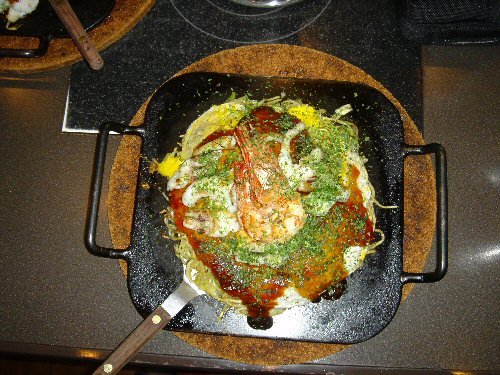
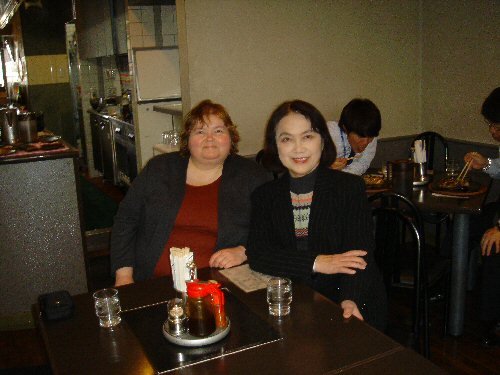
 From "Popeye" in Hiroshima. What a cute name for an Internet Cafe. So back in the seat in the non-smoking section. Yesterday afternoon I had a long and wonderful meeting with Haruko Moritaki, and caught up on her dedicated activities to shed light on the harm being done with DU weapons. Totally amazing woman. We enjoyed a late lunch of Okonomiyaki, the signature dish of Hiroshima at Hanayashiki, then went to Shukkei-en, a lovely garden which had plum blossoms starting to bloom, despite the unusually cold weather. Some of the trees looked like weeping willows with the trailing branches weeping riotous complex pink blossoms.
Some photos of our Okonomiyaki Lunch:



I later met an old friend, "Jon" Koike in the lobby of my hotel.. 30 years since we were students together at Hiro-Dai Fuzoku koko. It was fantastic to catch up on each others lives since we last had the chance to sit and talk about three years ago. Silly me brought my camera, then became so engaged in our conversation that I forgot to take a photo. Zannen desu.
This morning, by sheer coincidence the cute young girl who served me breakfast at the hotel is currently a student at the same high school I attended 30 years ago.
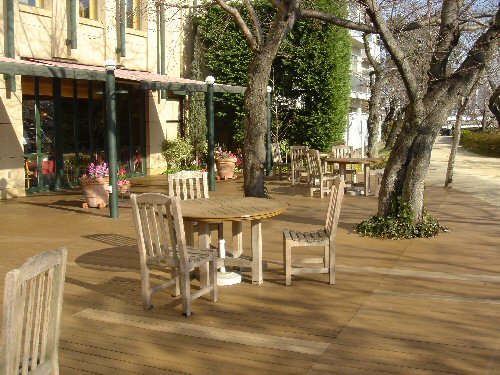
I sat on the wooden deck of the hotel after breakfast soaking in the early morning sun and romantic scenery, blossoms and trail by one of Hiroshima's famous rivers. Seemed the morning for dog walking along the trail, and the cleaning lady, sweeping an already immaculate deck, was so cheerful and smiley I would dare anyone who saw her not to have an uplift to their morning.

Thursday, March 02, 2006
From Hiroshima. I arrived in Osaka last night, and had the most wondeful dinner with Mr. Tetsumi Sato, and two of his associates, Tatsumi and Koji at "Loin", a teppan-yaki restaurant in the Shin-Hankyu Hotel. The chef was a master, we all had beef with vegetables, including matsutake mushroom, paired with some wonderful Chilian wine. We reminised about old times, and good friendships, and in particular remembered Dr. Barrett Scoville, a colleage we miss who passed on in a plane crash (he used to commute regularly from Connecticut to DC in his small plane).
I woke up early this morning, and took an early  Shinkansen (bullet train) to Hiroshima, checking my bags at the hotel and finding a lovely Internet Cafe from which I'm writing this. I saved my Shinkansen ticket for Toran, and even took a photo of the train I rode for him. Love making my young friends happy. I'll have to post photos in retrospect when I'm back in the U.S.
Sunday, February 26, 2006
Sonoma. After spending the morning on organizing the book tour, and getting things ready to go for Japan, I went to Sonoma. Had tea with Linda and took my Dad out to dinner at the "Happy Garden" Chinese restaurant. It was so-so, but my father enjoyd being out. It started pouring rain and the temperature dropped this afternoon ... BRrrrr...
 Another thing you'll never find on my table...
Chinese give cat food a whole new meaning
From Jane Macartney in Beijing
The Times
EVERY day thousands of cats are transported to Guangdong province in southern China.
They are destined not to become the pampered pets of the country’s new rich, but to be served up at the dinner table.
The trade is one that merchants seem eager to keep out of the public eye in a country where pet shops have sprung up to meet a growing demand as incomes rise.
While no laws exist to regulate the business, at the Baishazhou market in Wuhan, central China, two cat traders were startled this week when a local reporter paused to take photographs.
They had collected about 1,000 cats, taken to the city by rural cat-catchers. The terrified animals were crowded into large wire cages.
All were alive, but most were silent, apparently too exhausted and traumatised to do more than mew faintly. The traders loaded about fifteen cages, each crammed with cats, into the back of a van for the animals’ final journey to Guangdong. Chinese have for centuries eaten a startling range of creatures. Southern Chinese particularly relish the taste of wild animals, believing them to be rich in nutrition.
Wild civet, banned since the severe acute respiratory syndrome (Sars) scare, is believed to boost the immune system. Snakes are reputed to increase a man’s virility, and the smooth-skinned salamander is believed to clear acne.
In the markets of Guangdong, cats cowering in small cages are a common sight. At the Nanjin poultry market about forty stalls sell cats, which are divided according to size. The larger the cat, the higher the price. A cat weighing more than 3kg (7lbs) can fetch 70p a kilo, while smaller animals cost about 40p a kilo.
A local newspaper quoted one trader as saying that he sold up to 300kg (660lb) of cat meat a day. He said: “Today I’ve sold 200 cats. Tonight another 100 will arrive. No matter how many you need, I can satisfy demand.”
Catching cats offers an alternative source of income for farmers in China’s poorer central provinces who sell them for up to 40p each. One Guangzhou restaurant offers a braised cat meat dish for £3, but charges £12 for cat stewed with snake and chicken. The owner said: “The cats are domestic cats and are clean and cheap. In winter we have more customers than in summer. Only local people eat cat, not people from other provinces.”
The Guangzhou City Food and health quarantine office said that there were no regulations regarding cat meat.
Saturday, February 25, 2006
 Another We-Eating. Michael was too ill to join in person, but Jo-Ann & I enjoyed our meeting, Michael joining by speaker phone after we'd finished our enjoyable Japanese-style brunch. We took photos to memorialize our theme.
Brunch Menu: Barazushi, Ajitsuke Daikon, Tempura Shrimp, Kiri-gobo, fresh organic farmer's market baby greens with miso-mustard dressing and cherry blossom carrots, oden, miso soup, organic stawberries in birch sugar, and a good Merlot. 
We started at 10:00 and ended at 2:00 -- mid-way Jonathon & the kids turned up and wanted to swim in my frigid pool -- if they could brave it! So they took a Swedish dip, and returned later. We all went walking across the Golden Gate Bridge afterwards enjoying a spectacular view of the city and good looks at the cables and structure of the bridge underneath us. Back to my place for some hot chocolate/tea and to warm up!

Friday, February 24, 2006
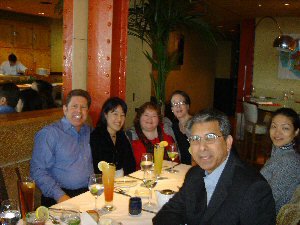 A Farewell to Remember. My friends at OAI threw a farewell lunch for me today celebrating my 22 years with the company. We enjoyed a fabulous feast at Chaya, and moving around the table I enjoyed visiting with all. I was presented with a Mont Blanc pen with enscription "From Friends at OAI" and a most beautiful bouquet of flowers. It was lovely to have such appreciation.
 Hugs and warm wishes, and interest in my new endeavors as a consultant were all part of the mix.
What a send off to the future!
Monday, February 20, 2006

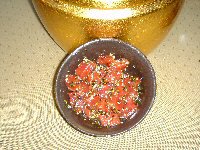 Dinner tonight. It's President's Day, and I took some time to enjoy some 'play' time with my Dad. I picked him up, took him to lunch at his favorite buffet... then we went to see Duma at the Rafael. What a fabulous movie. VERY worth seeing. A little too intense for tots, but great! Dad enjoyed it too.
On my way home I checked messages... uh oh... my Doctor's nurse calling. I called her back. oh yes, that little matter of a certain test. Don't I have to keep a certain diet before completing? Yes, hmmm... it's on the back? When? Well.. yes I'll do it, but I happen to like a lot of the raw vegetables it prohibits, and well, then there's the matter of the raw meat... well of ... ahem. I DO enjoy raw tuna and it's on the menu tonight, and again I'm making it for a friend on Thursday. Bad? How do I know what's in it? I trust the source.. why, well, I only buy from a trusted source in Japantown. Can I SEE what's in it.. well, no.. (oh I'm just putting my foot in it futher, I'd best give up this conversation)... I see, yes, I'm sure Doctor will have something to say to me about it.
All caution tossed to the wind, and well, as to the matter of the incomplete test, it will have to wait until next week.. as I enjoy my tuna pokki tonight -- photo above of tonight's dinner. I'm going to do seared black-sesame coated tuna with a ponzu/green onion sauce for Thursday.
Sunday, February 19, 2006
 Lunch at Il Fornaio, Palo Alto. I enjoyed a marvelous lunch with Wilma this afternoon. It was unseasonably crisp and cold in Palo Alto, but we were tucked away inside and enjoyed Italian 'comfort food', with a little splurge on some drinks to toast to what's up next. I had a Bellini (peach juice & white wine blend).
I met Paul at Standford shopping mall and did a little pre-trip gift shopping. (Yes, I'm off to Japan next week!) 
I also had some fun with my new roommate -- my iRobot Roomba. What a cute creature! He took care of all those dust bunnies under the bed while I was reading a book... wow!
Tuesday, January 24, 2006
 Supper Club Recipe (France). Following is Emil's information about the origin of the cheese served last Saturday, and instructions for storing cheese, etc. (Emil, Caren & Anna left)
Fromages Françaises
The French cheeses we served at our Supper Club Feast were purchased at Au Vieux Gourmet, a cheese store with a huge selection of fabulous cheeses, located at 3, rue des Orfèvres, Strasbourg, near the cathedral, and included:
Abbaye de Trois Vaux – handmade cheese of nuns in Normandy
Chevrotin – artisan goat cheese from Savoy
Gaperon – speciality of Auvergne
Grisie du Jura – Savoy
Gouda Rouge Vieux – aged for 3 to 4 years
Livarot – one of the oldest cheeses of Normandy, highest rate of consumption
Pyramide Cendrée – goat milk
Royal Briard – artisan cheese from Île-de-Françe
Resources for French cheeses:
http://www.fromages.com/cheese_library.php
http://www.cheesesupply.com/
http://www.francefromages.com/m32_encyclopedie_tous.asp
http://www.france-gourmet.com/gb/cfm/boutique/index.cfm
No matter how far archaeological finds go, there is evidence that cheese came into being in prehistoric times. Cheese can not really be said to have been "invented". This delicious food must have resulted from the simple observation that milk left in a container ends up by coagulating, even more if it is hot. People living in areas where the climate changed seasonally would also have noticed the effect of temperature on this process: in warmer weather the milk would curdle faster than in the cold. This might be considered the first technological cheesemaking discovery.
There are hundreds of different types of cheese that can be differentiated both by the type of milk - raw, skimmed or pasteurised, and by the animal - cow, goat, sheep, buffalo, horse or camel.
Serving and Storage Tips
Unpasteurised cheese with a range of flavours should not be sliced until purchase otherwise it will start to lose its subtlety and aroma.
Keep the cheese in conditions in which it matures. Hard, semi-hard and semi-soft cheeses are stored in the temperatures from around 8 - 13 C.
Keep the cheese wrapped in the waxed paper and place it in a loose-fitting food-bag not to lose humidity and maintain the circulation of air.
Wrap blue cheeses all over as mould spores spread readily not only to other cheeses but also to everything near.
Cheeses contain living organisms that must not be cut off from air, yet it is important not to let a cheese dry out.
Do not store cheese with other strong-smelling foods. As a cheese breathes it will absorb other aromas and may spoil.
Wrap soft cheeses loosely. Use waxed or greaseproof paper rather than cling film.
Let cold cheese warm up for about half an hour before eating to allow the flavour and aroma to develop.
Monday, January 23, 2006
 Supper Club Recipe (France). Our tireless organizer, and professional chef Tom (left) sent along his recipe from Corsica.
Mouton aux Olives (Lamb with Olives)
SERVES 6
Meat stews are a hallmark of Corsican cooking, and with good reason: The herbs that go into them are the same ones that the animals graze on, creating a unique layering of flavors.
4 oz. bacon, diced
1 medium yellow onion, peeled and chopped
2 medium cloves garlic, peeled and minced
2 lbs. lamb shoulder (have butcher cut into medium pieces)
1 tbsp. flour (I used chestnut flour, which you can find at Andronico's, but it's not necessary)
2 tbsp. tomato paste
1 cup red wine
4 sprigs fresh thyme
3 sprigs fresh rosemary
Salt and freshly ground black pepper
2 bay leaves
6 medium carrots, peeled, trimmed, and sliced
1/2-1 cup picholine or other good French or Italian green olives
1. Render and crisp bacon in a heavy pot over medium-high heat. Reduce heat to medium, add onions and garlic, and cook, stirring often, until soft, about 5 minutes.
2. Stir in lamb and cook until no longer pink, about 5 minutes. Add flour and cook, stirring often, until juices thicken and flour loses its raw flavor, about 10 minutes. Add tomato paste, wine, thyme, rosemary, and salt and pepper to taste and simmer for 5 minutes.
3. Add 2 cups water and bay leaves, bring to a simmer, and cook, stirring often, until lamb is tender, about 1 hour.
4. About 30 minutes before lamb is finished cooking, stir in carrots and olives. Before serving, skim any fat from liquid and remove and discard bay leaves. Serve warm with slices of chestnut flour pulenda, if you like.
Sunday, January 22, 2006
 Supper Club Recipe (France). Now the recipes are starting to circulate from our fabulous chefs for the delights of the evening. Let's start with Paul's Recipe. Paul traveled all the way from Massachusetts for the event. I'm not particularly fond of duck, but this was GREAT. Not fatty!
BRAISED DUCK WITH PORT AND CHERRIES
4 large Moulard duck legs, including thighs (about 12 ounces each)
THE SPICE RUB
1 teaspoon coriander seeds
1 tablespoon chopped fresh thyme or 1 teaspoon dried
1/2 teaspoon black peppercorns
1 1/2 teaspoons coarse salt
1/2 teaspoon allspice berries
THE BRAISE
1/2 cup (3 ounces) dried Bing cherries (with 1 cup chicken stock, homemade
1 cup tawny port
Coarse salt and freshly ground black pepper
1 large shallot, thinly sliced
1 bay leaf
1. Trimming the duck-the day before: Trim the duck legs of as much excess fat as you can without cutting into the skin or the meat. If you've never trimmed duck legs before, proceed slowly to avoid trimming off the skin with the fat. Unlike chicken, duck skin and fat can be hard to distinguish. After removing a maximum of fat, trim off any loose flaps of skin as well. Depending on the duck, there may be as much as 4 ounces of fat to trim off each leg. Collect the fat to render at another time and use it for sauteing potatoes or other vegetables, or discard.
2. The spice rub: In a small mortar or spice grinder; combine the coriander, black pepper- corns, and allspice and grind to a coarse powder. Add the thyme and salt and mix. Sprinkle this spice mixture all over the duck legs and rub so the seasonings adhere. Arrange the duck legs in a single layer in a baking dish, cover with plastic, and refrigerate overnight.
3. Plumping the cherries-the day before: In a small bowl, pour the port over the cherries. Set aside to plump overnight.
4. Heat the oven to 325 degrees.
5. Browning the duck: Pat the surface of the duck dry using paper towels, being careful not to wipe off the spices. Heat a large heavy skillet (10- to 12-inch) over medium-high heat: If you have a cast-iron skillet, this is a good place to use it. Because it holds heat so well, it sears the duck legs without having the skin stick or tear. If you don't have cast iron, choose the heaviest skillet you have. Don't worry that there's no fat in the pan; the duck legs will quickly throw off enough to get things sizzling. When the skillet is hot but not scorching, add as many duck pieces skin-side down as will fit without crowding. Sear the duck, without disturbing, until the skin is crisp and taut, about 7 minutes. Lift one edge with tongs to peek to see that the skin is crisp before turning. Panfry the other side just until spots of brown appear, another 3 to 4 minutes.
Transfer the duck to a shallow braising pan (4- to 5-quart). Pour off all the excess fat and repeat with the remaining duck legs. Pour off the fat, this time reserving 2 teaspoons in a small jar or ramekin. and remove any black specks from the skillet with a damp paper towel. Don't dean away any tasty cooked- on browned bits that will later add depth of flavor to the braising liquid.
6. The aromatics and braising liquid: Return the skillet to medium heat, add the
reserved 2 teaspoons duck fat and the shallot, and saute until the shallot begins to soften, 1 to 2 minutes. Add the cherries and their soaking liquid, increase the heat to medium-high, and simmer to reduce the liquid by half, about 5 minutes. Add the bay leaf and stock and reduce again by half, another 8 minutes.
7. The braise: Pour the reduced port-stock mixture over the duck legs. Cover with parchment paper, pressing down on the paper so it nearly touches the duck and extends over the sides of the pan by about an inch. Cover with a tight lid. Slide into the middle of the oven to braise at a gentle simmer. Lift the lid of the braising pan during the first 30 minutes to check that the liquid isn't simmering too forcefully. If it is, lower the oven temperature 10 or 15 degrees. After 1 hour, turn the duck legs with tongs. Continue braising gently until the duck is fork-tender and pulling away from the bone, another hour or so (about 2 hours total).
Remove the duck from the oven, and, with tongs, arrange the legs skin side up in a single layer on a half sheet pan or broiler pan. Cover loosely with foil to keep warm. Increase the oven heat to 475 degrees.
8. Degreasing the sauce: Duck legs release a substantial amount of fat when braised,
and if you own a gravy separator, this is a good opportunity to bring it out. Pour the brais- ing liquid into the separator, and then pour the liquid into a medium saucepan (2-quart), .leaving the clear fat behind. If you don't have a gravy separator, pour the braising liquid into the saucepan and skim the surface fat with a wide metal spoon.
9. Reducing the sauce: Set the saucepan over medium-high heat and simmer rapidly
until reduced to a syrupy sauce, about 3 minutes. Taste for salt and pepper, and lower the heat below a simmer to keep warm.
10. Meanwhile, crisp the duck: Once the oven has preheated, remove the foil and slide the pan of duck legs onto a rack in the middle or upper part of the oven and roast until the skin on top is crispy and sizzling, 8 to 10 minutes. Transfer to warm plates or a handsome serving platter.
11. Serving: Spoon the dried cherry and port sauce over the top of the duck. Serve.
Saturday, January 21, 2006
 Supper Club: French Regions. This evening was my introduction to the club, and I was happy to have Bretagne as my region. There were about 15 fabulous chefs present, including professional. The menu:
1. Salade d'Endives, Fromage, et Noix (Belgian Endive Salad with Cheese and Walnuts) - Auvergne
2. Fromage from different regions of France (photo left -Caren & Emil): Royal Briard, Chevrotin, Pyramide Cendrée, Livarot, Abbaye de Trois Vaux, Gouda Rouge Vieux, Grisie du Jura, and Gaperon - Various Regions of France
3. Tartare de Thon - Brittany
4. Chickpea and Spinach Soup with Almonds - Pyrenees 5. Egg and Wine Soup
6. Augergines et Fenouil Saint-Loup (Eggplant and Fennel with Tomatoes in an Egg-Cheese Custard) - Provence
7. Oysters Escargot in Mushroom Caps - Burgundy
8. Coq au Vin - Burgundy
9. Braised Duck Legs in Port with Cherries
10. Mouton aux Olives (Lamb and Olive Stew) - Corsica
13. Croquembouche w/ Grand Marnier Pastry Cream
14. "Salle Pleyel" as created by Robert Linxe of La Maison Du Chocolate on the rue du Faubourge-St. Honore' in Paris - Paris A very slow and much enjoyed meal... did not disappoint! My dish was the Tartare de Thon. I served it in an antique lidded glass pedestal dish, with sea salt from Brittany on the side.
The salt was quite special:
Salt: Velvet de Guerande "Le Tresor"
Velvet™ by Le Trésor is light gray in color and almost the consistency of flour. This is a very delicate crystal that has a "buttery" feel and taste as it melts on your tongue. This is a terrific salt to top any dish, its texture makes it ideal for snacks such as popcorn, sauces and salads. You will naturally use less of this salt because the crystals are so fine, you get maximum flavor from a small amount of salt.
*This salt is certified organic by France's Nature & Progrés. This is the most rigorous salt certification process, which equates to purity and quality.
Tartare de Thon
Serves 4 as an appetizer
1 lb. piece of tuna
2-3 tbsp. olive oil
2-3 tbsp. salad oil
2 fl oz/1/4 cup white wine vinegar
3 shallots very finely chopped
2 tbsp. capers, drained and chopped
1 tbsp. chopped chives
1 tbsp. chopped parsley salt and pepper
With a very sharp knife, clean the tuna fillets, removing all skin, bones and membrane. Chop the tuna finely with a knife and put into a bowl. Add the oils, vinegar, shallots, capers, chives and parsley and mix well. Season the tartare to taste, cover tightly with plastic wrap and leave to marinate 2-3 hours (in refrigerator). Serve with crisp pieces of toast.
Anna's tips: I made 1 1/2 times this recipe for the supper club. I used sashimi-grade tuna which is sold in blocks in Nijiya market in Japantown. This way there is no cleaning and removing undesireable parts, and it is precut in a way that makes it easy to slice, then chop and get a nice smooth finish. I used white pepper, and the Velvet de Guerande salt, with extra on the side as an add-on for individual taste. I used Enova oil as the 'salad oil'.